

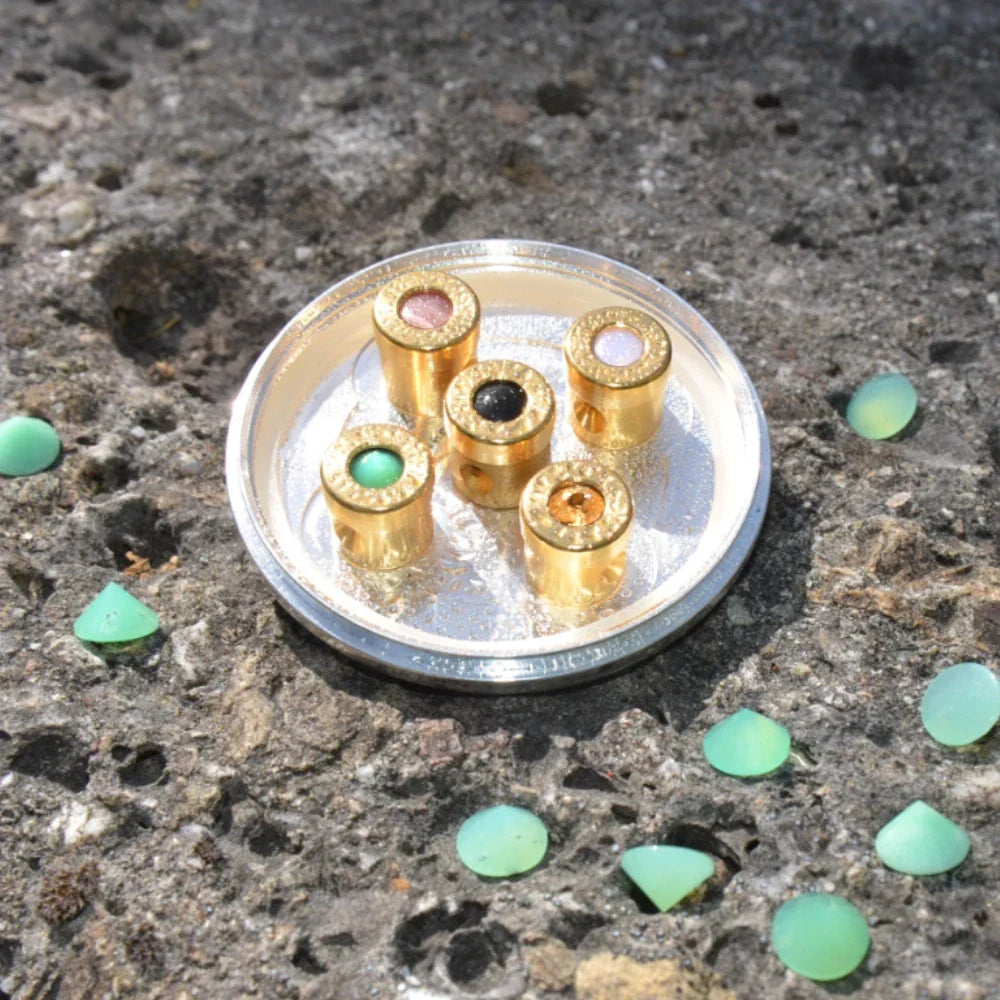
☀ Important Tips for Caring 💡 for Your Aquadea Products 🧪
Dear friends,
spring cleaning is also the right time to take your Aquadea products in hand and make them shine again.
We have revised our care instructions. They are now even more detailed, so that no questions remain open, you can care for your products in the best possible way and enjoy them for a long time.
Why do we use bronze and titanium as the base material – and not brass or stainless steel? Because they are metals that carry fine vibrations very cleanly and clearly. Because brass contains lead and vibrates dully. And stainless steel offers hardly any support on the subtle level and, with drinking water, is not convincing in taste either.
Warranty and care of AQUADEA water vortex chambers
We at AQUADEA grant you a 2-year warranty on function, provided the recommended care is observed. With products that are electroplated or coated, for example with gold or silver, it is possible that after prolonged use the coating develops small cracks and the underlying base material, such as bronze or titanium, becomes visible.
Exposed bronze “protects” itself by building up a fine, usually greenish oxide layer – which is neutral. But not so nice to look at.
Such damage can be caused by production or coating defects, which we examine carefully and replace under the warranty, or it is caused by incorrect cleaning and care.
If care and handling are not carried out according to the instructions, unfortunately we cannot offer a warranty. The function of the product, however, remains intact. Please contact us in the event of damage, even if it is self-inflicted, so that we can offer you a suitable solution.
To avoid visual impairments, we recommend reading and following the care instructions carefully. Small scratches, cleaning marks or signs of use are completely normal and cannot be avoided, but they do not affect the function of the product.
Care step by step
Step 1: Descaling with citric acid
As the basis of every cleaning, you should first free the product from limescale. Depending on the lime content in the different regions, you will need to do this at different intervals, which is why we cannot give a general recommendation here. However, you should check every few weeks whether it is time again. The more regularly this is done, the easier and quicker the cleaning will be. If limescale has not been removed for a year or longer, for example, and has baked onto the silver layer – it can hardly be removed without leaving marks.
First unscrew your Trinity or ToneOne and any combinations, or unscrew the shower plate from the bell. Take a glass bowl, fill it about 5 cm (2 in) high with warm water (about 200–400 ml), add a teaspoon of pure citric acid (e.g. HEITMANN) and stir briefly. Depending on how dirty they are, leave the products in the water for 5–15 minutes. Then rinse with clear water.
Important! Do not use acetic acid, vinegar essences, vinegar-based products or any other cleaning agents, as these can attack or even destroy the metals and also the crystals. Vinegar reacts with materials that contain copper, and a harmful and unhealthy oxide layer can form. This only happens with vinegar.
Caution! With products containing calcareous stones such as Larimar, lapis lazuli and azurite-malachite, citric acid begins to dissolve the semi-precious stones – and if the contact is too long, dissolves them completely.
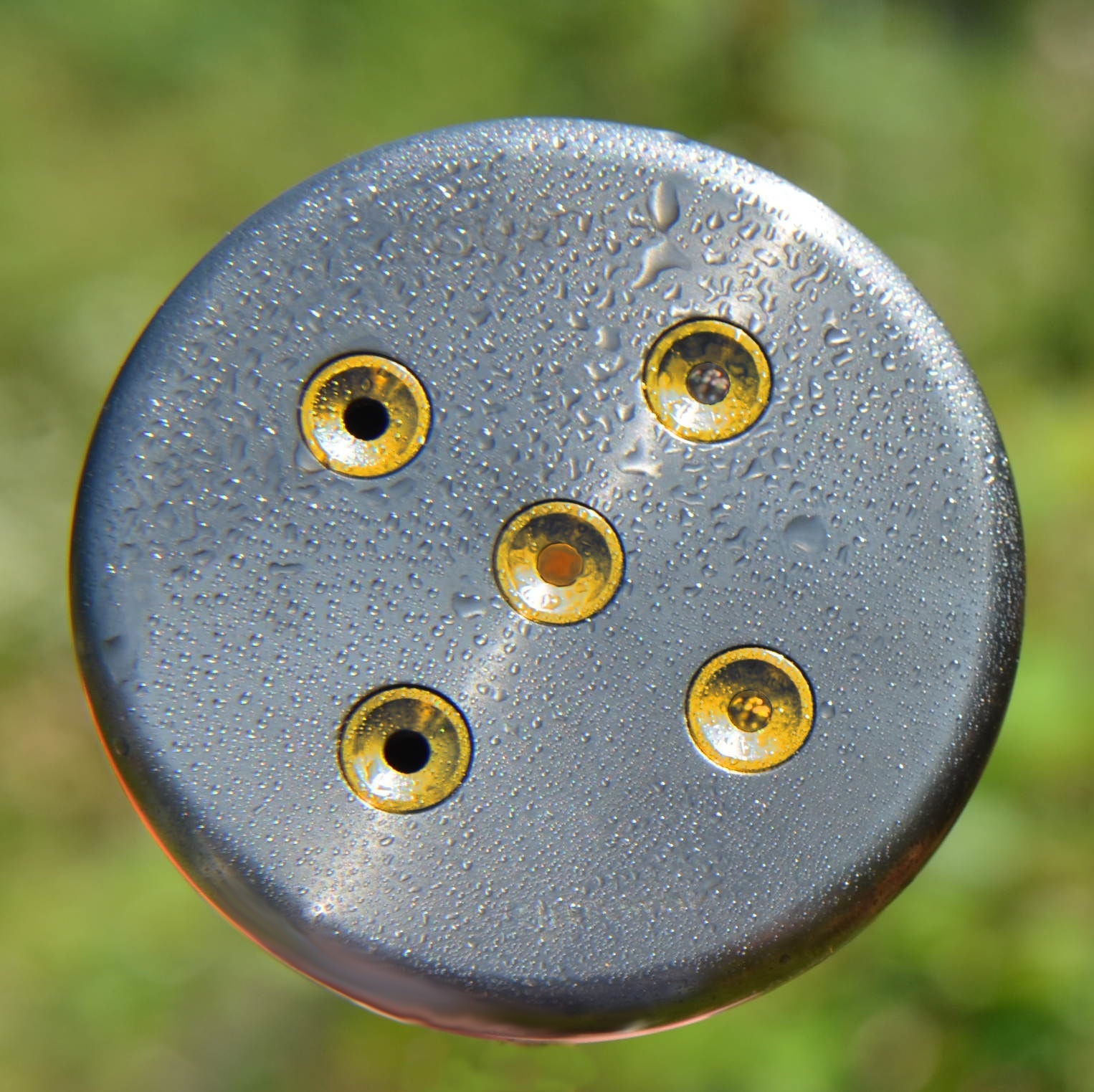
If you place the resonance plate of a shower in the water with citric acid, you can still clean the plate as long as the crystals do not come into contact with the citric acid. Make sure that you fill the bowl with only 1 cm (0.4 in) of water, so that the resonance plate is in contact, but not the calcareous stone.
Tip! To avoid limescale deposits from standing water, we recommend patting the jet nozzle dry once a day, or the shower plate after showering, with a cotton cloth that is as lint-free, clean and soft as possible. To remove the water from the shower hose with one click, we also offer a Nito connector in our shop. This keeps your shower hose germ-free for longer.
Note on bronze products: With pure bronze products, as well as bronze products with small flaws in the electroplated precious-metal layer, green oxidation can occur that looks very similar to verdigris. Verdigris, however, only forms through contact with vinegar.
Step 2: Cleaning with Hagerty Silver & Multimetal Foam
Metals can oxidize, and besides limescale this can lead to further soiling. For this there is the Silver & Multimetal Foam from Hagerty. Using the enclosed sponge, the foam can be carefully dabbed on until it foams up. Let it work until it has dried, and then rinse the foam off under running water with the sponge. This foam is suitable for all metals and is usually sufficient with regular care.

Step 3: Cleaning with metal-specific cleaning agents
Insufficient care, or sometimes the regional water quality, can lead to heavier soiling, which then requires more intensive care.
For silver and the metals ruthenium, platinum, palladium and rhodium, we recommend Hagerty Silver Polish. You can carefully dab on the polish with a cotton swab or cotton pad. Let it work until it has dried. Wash off the polish under running water with a very soft sponge or cloth.

For gold, which may develop brownish spots under certain circumstances, Hagerty offers the so-called Gold Clean. First, the product is placed in the liquid, if its size allows. Afterwards, the dull areas can additionally be cleaned with circular movements using a soft cloth that has been dipped in the liquid. If you are cleaning a shower plate, you can skip the first step and polish the plate directly with the soaked cloth.

For bronze, which naturally oxidizes quickly, Hagerty also offers Copper, Brass & Bronze Polish. Bronze is robust, so you can work with a little more pressure here than with electroplated products. Apply the polish, let it work until it has dried, and then rinse it off under running water with a soft sponge. You will then once again have radiant, brightly shining bronze. Gold-like. If there are scratches, bronze can also be sanded beforehand with sandpaper. First with coarser sandpaper (e.g. 300 grit), then with very fine paper (1000 grit) – and then polished with bronze polish.

If you have further questions about proper care or are unsure which care product is best suited for your product, send us an e-mail at vertrieb@aquadea.de or call us at +49 8135 - 99 474 55.
Individual components of a vortexer or a shower, or of a shower handle, can be reordered from us. We also offer to clean your product in-house: ToneOne: €30, Trinity: €50, shower: €40. Should individual parts need to be replaced, we would inform you, quote a price and obtain your consent.
With a Crystal Vortex™ shower, individual crystals can be exchanged.
Under this link you will find our gemstone list.
Exchanging a crystal costs €30 + the price of the new crystal.
Exchanging/replacing a vortex chamber with another chamber:
Surcharges:
- Gold-bronze chamber: + €50
- Exo-Plasma G chamber: + €50
- Silver-bronze chamber: + €25
- Platinum-bronze chamber: + €60
- Ruthenium-bronze chamber: + €30
- Exo-Plasma Crystal Vortex™ chamber: per chamber: €50 (extremely high-vibration vortex chambers, diamond-like effect)
With a ToneOne with pre-vortex chamber, the chamber and the crystal cannot be exchanged.
All prices plus shipping.


Leave a comment
This site is protected by hCaptcha and the hCaptcha Privacy Policy and Terms of Service apply.